Search
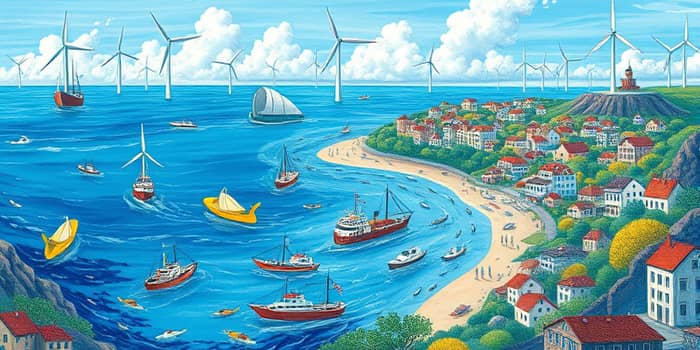
The vast oceans that cover our planet are not just sources of beauty and wonder; they are emerging as powerful engines of economic prosperity. Embracing the blue economy means harnessing the ocean's resources in ways that foster sustainable growth and environmental stewardship, creating a future where both people and the planet thrive.
This transformative approach shifts from exploitation to regeneration, balancing economic benefits with the health of marine ecosystems. It's a vision that inspires hope and action, inviting us all to participate in building a resilient world.
From coastal communities to global markets, the blue economy is already making waves, offering immense opportunities for innovation and investment. By understanding its core principles and practical applications, we can unlock its full potential and drive positive change.
The blue economy, also known as the ocean economy, revolves around the sustainable use, restoration, and stewardship of ocean and coastal resources. It emphasizes practices that regenerate ecosystems while driving economic growth.
At its heart, this concept challenges traditional models of resource extraction. Instead, it promotes a harmonious relationship with the marine environment, ensuring that development does not come at the cost of degradation.
Key elements include a focus on long-term viability and the integration of environmental, social, and economic goals. This holistic approach is essential for creating a sustainable future.
The economic significance of the ocean has grown dramatically over the past decades. From a valuation of approximately $1.3 trillion in 1995, it has doubled to $2.6 trillion by 2020, with projections suggesting it could quadruple by 2050.
This growth outpaces the global economy significantly, highlighting the ocean's increasing role in trade and development. For instance, ocean-related exports reached $2.2 trillion in 2023, accounting for about 7% of world trade.
Drivers of this expansion include leadership from developing countries and a rebound from COVID-19 disruptions. These factors underscore the dynamic nature of the blue economy.
Several core sectors are at the forefront of the blue economy, each offering unique opportunities for sustainable development. These sectors not only contribute significantly to global GDP but also have the potential for regenerative practices that balance benefits with environmental integrity.
Here is a comparison of some key sectors to illustrate their impact:
Other promising areas include renewable energy, blue infrastructure, and circular economy initiatives. The World Economic Forum identifies six regenerative sectors that need significant investment to achieve sustainability goals.
The blue economy is a major source of employment, supporting millions of livelihoods worldwide. Globally, over 600 million people rely on ocean-based industries, with direct jobs in fisheries and tourism being particularly significant.
In the United States alone, the ocean economy contributes 2.6 million jobs with an average salary of $85,000. This highlights the quality of employment opportunities available in this sector, making it a key driver of socio-economic development.
Benefits extend beyond jobs to include higher productivity and enhanced revenues for businesses engaged in sustainable practices. These advantages foster resilient communities and economies.
Despite its potential, the blue economy remains underfunded, receiving less than 1% of official development aid and philanthropic capital. This gap presents a frontier for investors making positive impact, offering opportunities in blue bonds, dedicated funds, and bankable projects.
Early movers can gain resilience and supply chain advantages, positioning themselves for long-term success. Key investment needs include developing financial models that support regenerative practices and creating projects that are both profitable and environmentally sound.
While the opportunities are vast, the blue economy faces significant challenges that must be addressed to ensure its sustainability. Environmental risks such as climate change, pollution, and ecosystem degradation threaten the very resources that underpin this economy.
Over half of the global GDP is nature-dependent, making the health of ocean ecosystems critical to economic stability. Tipping points loom if business-as-usual practices continue, emphasizing the need for urgent action.
Economic and social challenges include underfunding, job losses from disruptions, and resource depletion that harms local communities. To overcome these, growth must prioritize equity and environmental health over mere GDP expansion.
Looking ahead, the blue economy is poised for exponential growth, with projections suggesting it could reach over $10.4 trillion by 2050. A sustainable shift could double its contribution to global GDP by 2030, driven by innovation and regenerative practices.
Innovation will play a key role in this transformation, with examples including electrifying shipping, restoring mangroves, and regenerating coral reefs. These efforts not only drive economic growth but also enhance ecosystem resilience and long-term viability.
By focusing on collaborative efforts and commitment from all stakeholders, we can unlock a future where the ocean economy thrives in harmony with nature. This requires inspired action and practical steps today.
Across the globe, regions are demonstrating the power of blue growth. Developing economies lead in expansion, with surpluses in services trade, while the European Union shows a strong trajectory in renewable energy sectors like offshore wind.
In the United States, tourism dominates the marine GDP, and states like Maine are pioneering equitable innovation models beyond metrics. These examples provide practical blueprints for others to follow, showcasing how sustainable practices can yield tangible benefits.
Embracing the blue economy is not just an economic imperative; it is a moral one. By tapping into blue growth, we can create a world where prosperity and planetary health go hand in hand, securing a vibrant ocean future for generations to come.
References