Search
The world stands at a crossroads, with food insecurity escalating and environmental pressures mounting.
Recent data reveals a 20% increase in people facing acute hunger, driven by conflict and climate shocks.
This crisis underscores the urgent need for transformative approaches in agriculture to ensure a sustainable future.
In this article, we explore the challenges, innovations, and practical steps that can help us feed the growing population while protecting our planet.
Global food insecurity has worsened significantly, affecting millions worldwide.
The WFP 2026 Global Outlook reports that over 295.3 million people across 53 countries are impacted.
Conflict remains the primary driver, but climate change is now a persistent threat.
Agriculture contributes heavily to environmental degradation, with 90% of global deforestation linked to farming expansion.
This leads to land degradation, reducing productivity and harming ecosystems.
UNESCO projects that without intervention, 90% of Earth's land could degrade by 2050.
Additionally, agriculture emits substantial greenhouse gases, with EU contributions at 11% and global levels rising.
Climate change further reduces crop yields, even with adaptation efforts.
The demand for food is also increasing, with FAO estimating a 60% growth by 2050.
This includes rising production of animal proteins, such as meat and dairy.
To address these issues, we must adopt sustainable practices that balance productivity with environmental care.
Global agricultural markets show varied signals, with some commodities well-supplied and others facing price volatility.
For instance, wheat inventories are expanding, reaching record highs in some regions.
Specific data highlights significant increases in crop production, such as grain maize in Hungary.
USDA forecasts indicate record wheat yields in countries like China and Argentina.
However, stagflation persists in agroindustry, with overproduction and stable input prices.
This mixed outlook requires careful management to ensure food security and economic stability.
Innovations in farming can help optimize production and reduce waste.
Sustainable agriculture is evolving with cutting-edge practices that enhance resilience and efficiency.
Regenerative agriculture, for example, focuses on improving soil health and biodiversity.
This market is growing rapidly, projected to reach $5.77B by 2034.
Techniques like no-till farming and cover cropping reduce chemical use and water needs.
Carbon farming is another key trend, with practices such as biochar application.
It aims to cut carbon footprints and has a CAGR of 11.58% through 2028.
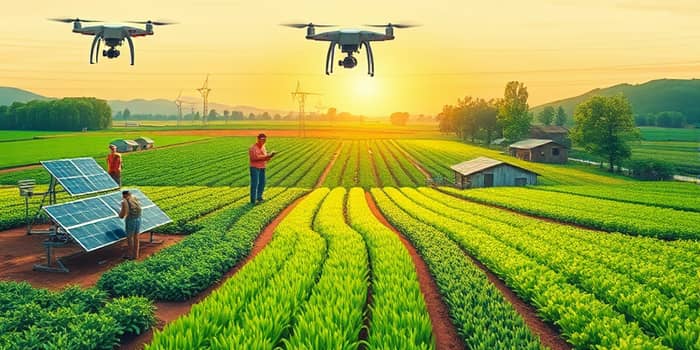
Precision and predictive agriculture leverage AI and data models to optimize farming.
By 2026, over 60% of large farms will adopt such technologies.
Tools like GPS and satellite imagery enable per-meter input management, lowering costs.
Other innovations include bioengineering for edited crops and agrochemicals.
Crop traceability using blockchain and IoT can reduce waste by 20%.
These advancements are crucial for building food systems that can withstand future shocks.
Major initiatives worldwide are driving progress in sustainable agriculture.
The World Bank has launched several programs to enhance food system resilience.
For instance, the $2.75B Food Systems Resilience project supports crisis response in Africa.
It benefits millions of farmers by improving production and market access.
In the Sahel region, irrigation projects have helped over 130,000 farmers.
These efforts cover thousands of hectares, boosting water management and crop yields.
Other programs, like AICCRA in Africa, have reached 3 million farmers with climate-smart tools.
This has led to increased incomes and higher yields, such as in Mali.
Non-governmental efforts, like Ryss, promote chemical-free farming in multiple countries.
These initiatives demonstrate that collaborative action can yield tangible results.
They align with UN SDGs, tracking progress towards sustainable and productive agriculture.
The economic landscape for agriculture in 2026 presents both challenges and opportunities.
Stagflation is expected to continue, with high inventories and oversupply in some sectors.
Energy prices may remain stable, but political factors could influence costs.
Global economic growth will drive food demand, especially in developing countries.
By 2026, their share of trade is projected to rise to 44% from 38%.
Population growth towards 10 billion by 2050 intensifies the need for efficient systems.
A strong USD may affect international trade dynamics.
To thrive, farmers and policymakers must embrace innovation and sustainability.
Practical steps include investing in technology and supporting regenerative practices.
By doing so, we can create a more resilient and equitable food future.
Individuals and communities can contribute to sustainable agriculture in meaningful ways.
Start by supporting local farmers who use eco-friendly practices.
Advocate for policies that promote regenerative agriculture and carbon farming.
Educate yourself on food waste reduction and traceability systems.
Invest in or adopt precision agriculture tools if you're involved in farming.
Collaborate with organizations working on global initiatives for food security.
By taking these actions, we can collectively build a world where no one goes hungry.
Sustainable agriculture is not just a necessity; it is a beacon of hope for future generations.
Let us nurture the land and each other, creating a legacy of abundance and care.
References