Search
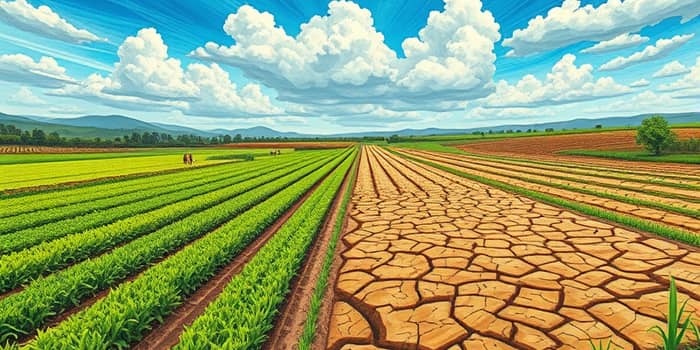
Our planet is at a critical crossroads where climate change directly threatens the very foundation of human sustenance: food security.
With food systems contributing one-quarter of all heat-trapping pollution, the cycle of environmental degradation and hunger is accelerating at an alarming rate.
Global hunger statistics reveal that 673 million people faced hunger in 2024, a stark contrast to the world's ability to produce enough food for billions.
This article explores how rising temperatures, extreme weather, and systemic vulnerabilities are reshaping our food landscape.
It delves into the data, impacts, and practical solutions needed to navigate this crisis.
Climate change drives profound reductions in staple crop yields, including maize, rice, wheat, and soybeans.
By 2050, global commodity prices could rise by up to 18% compared to no-climate-change scenarios.
This price surge may push 78 million more people into chronic hunger, primarily in low- and middle-income countries.
Offsetting this hunger increase requires an estimated $24.7 billion annually in investments for agricultural research and infrastructure.
The interplay between emissions and food production creates a feedback loop that exacerbates both environmental and social challenges.
Despite producing enough food for 8.2 billion people, hunger remains a pervasive issue.
In 2026, projections indicate 318 million people in acute hunger, with 41 million at emergency levels or worse.
Food insecurity is expected to remain alarming, with 110 million needing operational support from organizations like the World Food Programme.
Progress toward Zero Hunger by 2030 has stalled, especially in regions like sub-Saharan Africa and South Asia.
Conflict is the top driver of hunger, fueling 20 food crises affecting 140 million people from 2023 to 2024.
Climate extremes, such as record-breaking heat in 2025, are now constant threats to food systems.
Rising temperatures dampen production capacity for most staple crops, even with farmer adaptations.
In the U.S., warming trends accounted for 19% of national crop insurance losses from 1991-2017.
A 1°C monthly temperature rise drives food price inflation that persists for at least 12 months.
By 2035, North American food inflation could increase by 1.4-1.8 percentage points per year under different warming scenarios.
This escalation is projected to rise to 1.9-3.9% by 2060, highlighting the long-term economic strain.
Extreme weather events, from droughts to hurricanes, directly damage crops and disrupt supply chains.
Different regions face unique challenges, with some areas bearing a disproportionate burden.
Global hotspots need better identification to protect at-risk agriculture from climate extremes.
Climate change affects all pillars of food security: availability, access, utilization, and stability.
Disruptions include local shortages, price hikes, and interrupted transport and storage.
Long-term trends like shifting rainfall patterns combine with extremes such as heat waves and wildfires.
Survey data shows that globally, rising food prices are the second-most felt climate impact after heat.
The U.S. National Climate Assessment highlights these disruptions as major threats to progress.
Cascading effects from farm to fork undermine nutritional safety and economic stability.
Shifting to climate-smart agriculture is crucial for building resilience.
This approach focuses on three key goals: boosting productivity, enhancing adaptation, and supporting mitigation.
Research priorities include identifying hotspots and modeling extremes to understand labor and economic impacts.
Policy needs are urgent and multifaceted.
UN reports note challenges but also opportunities via technologies like AI for improving food security.
Projections for 2026 indicate continued food insecurity, with the Zero Hunger goal by 2030 likely unattainable.
The Climate Risk Index 2026 shows 832,000 deaths from 1995-2024 due to climate inaction, with escalating costs.
Humanitarian funding has dropped as military spending rises, exacerbating crises in conflict zones.
Key metrics underscore the urgency of this issue.
To combat this, a concerted global effort is needed.
By embracing innovation and equity, we can forge a path toward a more secure food future.
References